
Elephant Sanctuaries in Phuket and Thailand - Visiting Phuket Elephant Nature Reserve and How to Choose a Sanctuary
Elephants in the forest, no riding and no shows
Phuket Elephant Nature Reserve is an elephant reserve in tropical forest where you watch elephants eating, walking and bathing - no riding and no bathing with them. Plus: how to choose an elephant sanctuary in Thailand.
Read the full story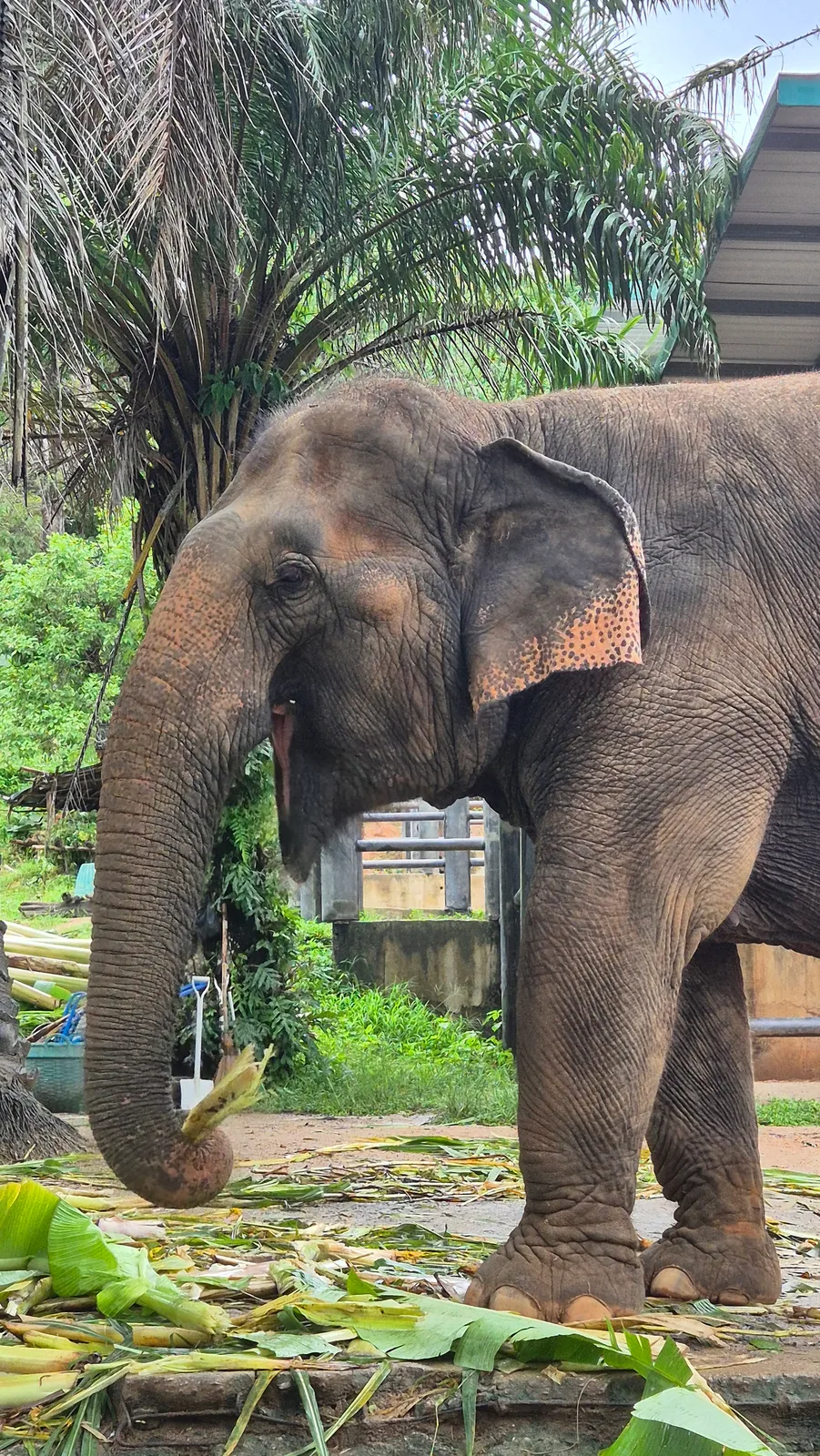
Meeting elephants is one of the special experiences you can build into a trip to Thailand. In Phuket, Chiang Mai and other areas there are elephant camps, reserves and rescue centres that let you see these impressive animals up close. But not every place that calls itself an elephant sanctuary works the same way. One of the most interesting in Phuket is Phuket Elephant Nature Reserve, an elephant reserve set in tropical forest where you can watch the elephants eating, walking and bathing in green surroundings, with no riding and no bathing alongside visitors.
Scroll sideways for all chapters →
01Elephant sanctuaries in Thailand - a special experience, but not all camps are alike
Elephants are one of the symbols most associated with Thailand. For hundreds of years they played a central role in local life, from forestry work and hauling loads to their place in culture and traditional ceremonies.
As the tourism industry grew, elephants also became an attraction for visitors. Riding, shows, feeding and bathing with elephants became common activities in some tourist areas.
But in recent years there has been a significant shift in the way elephant tourism is viewed.
Alongside the traditional camps, centres began to appear that offer elephants retired from work or rescued from harsh conditions a place where they can live in a more suitable environment.
In some places the elephants can roam wooded land, forage for food, rest in the shade and go into the water when they choose.
A visit to centres like these is different from the familiar riding experience. Instead of using elephants as entertainment, the emphasis is on observing them, getting to know their stories and learning about their behaviour.
It is important to know that the terms elephant sanctuary or elephant reserve do not in themselves guarantee any particular level of welfare. So it is worth checking how the visit is run and what activities are offered.
02Phuket Elephant Nature Reserve - an elephant reserve in tropical forest in Phuket
Phuket Elephant Nature Reserve is in the Thalang district in north-west Phuket, near Bang Tao and Layan.
The reserve was founded in 2019 and covers about 30 rai, roughly 4.8 hectares.
It is surrounded by tropical vegetation, tall trees and forest paths. The grounds include grazing areas, water sources and spots where the elephants can rest and cool off.
Unlike tourist venues where elephants stand in a line waiting for visitors, here the emphasis is on watching the animals within the reserve's habitat.
Visitors can see the elephants eating, walking around the grounds and sometimes playing in the mud or going into the water pools.
The visit combines an encounter with very large, impressive animals and a walk through green surroundings, far from the bustle of Patong's beaches and the tourist centres.
03What is special about Phuket Elephant Nature Reserve?
In 2024 the reserve adopted a policy focused on visits without direct contact with the elephants.
That means no riding, no bathing with visitors and no activities that require the elephants to perform shows or tricks.
Visitors are asked to keep a distance of at least five metres from the elephants while watching them.
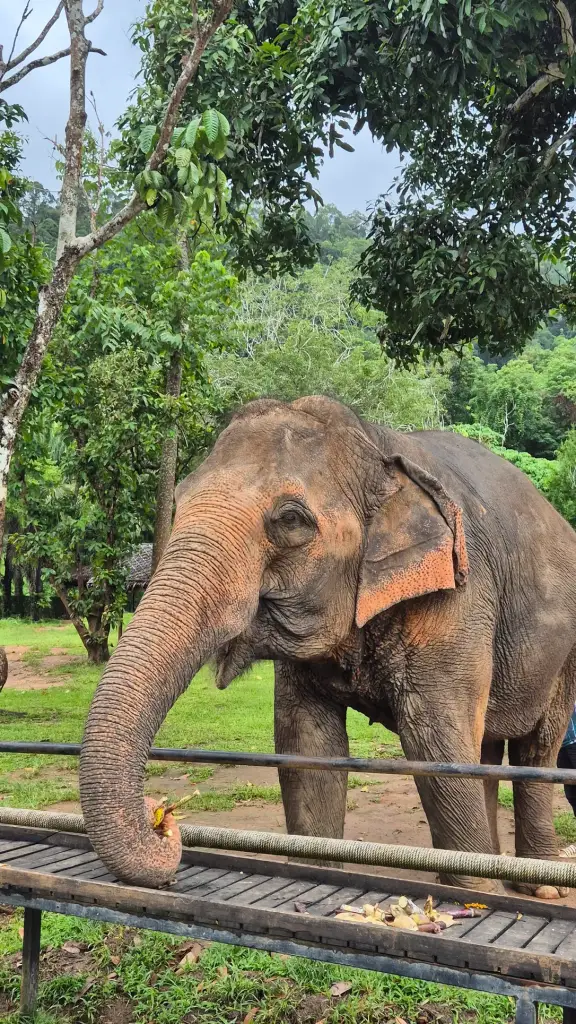
That said, the reserve also offers indirect feeding as part of some tours. This is not free feeding in which visitors approach and touch the elephants, but a controlled activity designed to keep visitors and animals apart.
It is important to understand that even among reserves considered responsible, there are differences in their approach to feeding. Stricter animal welfare organisations recommend choosing observation only.
What makes Phuket Elephant Nature Reserve distinctive is the combination of the forest setting, the educational programme and the chance to watch the elephants relatively close up, without taking part in bathing or riding.
04The elephants at the reserve - getting to know the animals behind the experience
One of the most interesting things about the visit is getting to know the elephants that live there.
Each elephant has its own name, history and personality.
The elephants featured on the reserve's website include Lotus, Bow, Thonglor, Nong Tang, Mae Boon Lai and Tub Tim.
Some of them came to the reserve after years of work or of living in captive conditions that did not suit their needs.
Their care includes an adapted diet, health monitoring and an environment that lets them move around and spend time with other elephants.
Elephants are highly social and intelligent animals. They communicate through sounds, touch, body movements and even low-frequency signals.
During a visit to the reserve you can also notice differences in the behaviour of different elephants.
Some elephants are more curious and active, while others prefer to stand in the shade, eat or move at a slow pace.
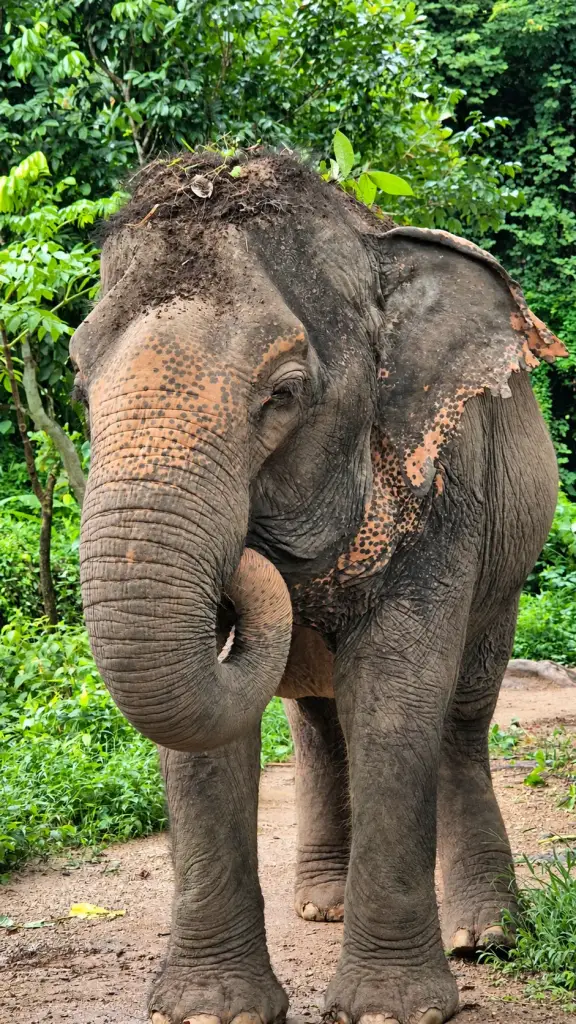
The experience is interesting precisely because the elephants are not expected to perform any scheduled activity for visitors.
05What do you see during a visit to the elephant reserve?
One of the typical sights on a visit is an elephant standing among the trees, eating.
Elephants use their trunks to grab branches, leaves and fruit, bring them to their mouths and explore their surroundings.
The trunk is one of the most impressive parts of an elephant's body. It is used for breathing, smelling, drinking, gathering food and communicating.
An elephant can pick up small, delicate objects with it, but can also shift heavy branches.
During the visit you can watch the elephants eating leaves and fruit, including bananas, watermelons and other foods that are part of their diet.
On some activities you can also see feeding through a dedicated feeder that separates the elephants from the visitors.
Watching an elephant eat relatively close up lets you notice the movements of the trunk, the way it holds the food and the pace at which it brings it to its mouth.
Besides feeding, you can watch the elephants walking the forest paths, resting in the shade or going into the water and mud pools, depending on what they want and on the weather.
06Phuket Elephant Nature Reserve in pictures
The original photos Reut took during her visit to Phuket Elephant Nature Reserve on 18 September capture the atmosphere of the reserve well.
In one photo, an elephant is eating banana leaves. In another, she is standing on the forest path with a watermelon.
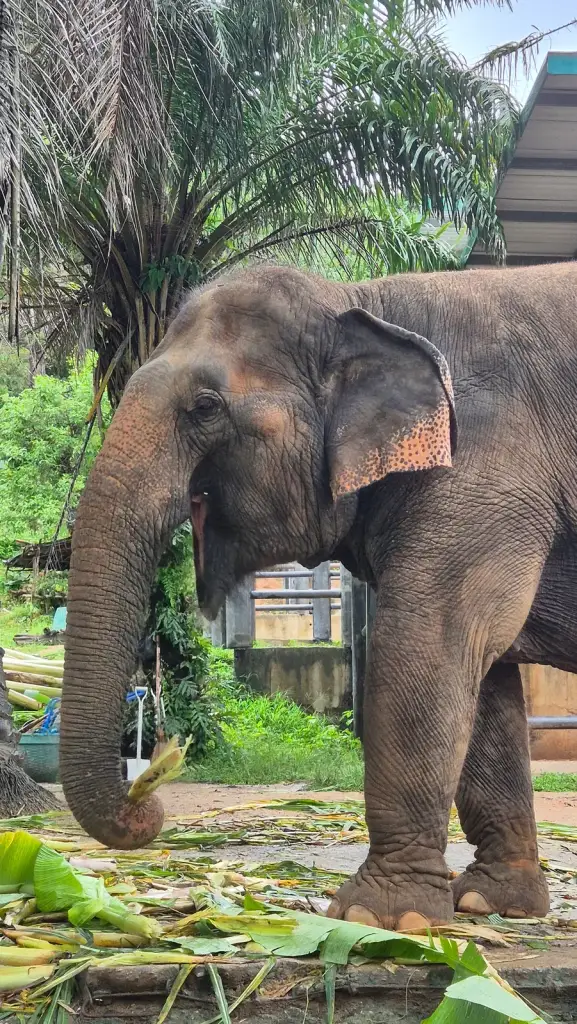
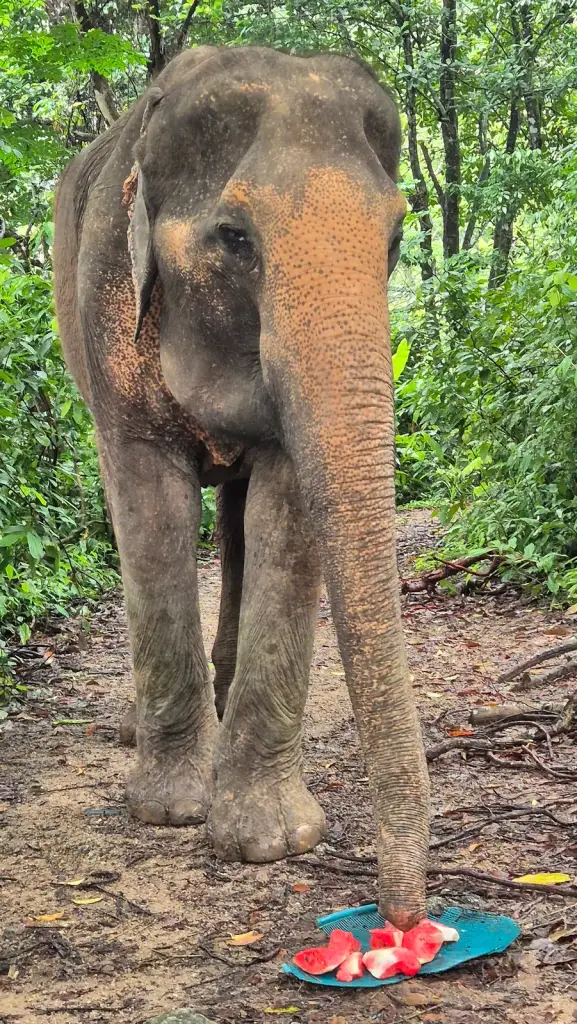
Other shots show an elephant lifting and curling her trunk, and an elephant feeding from a feeder.
The photos highlight one of the most interesting things about meeting elephants: even a simple, everyday action like eating can become an impressive moment to watch.
The flexible trunk, the precise movements, the sheer size of the animal and the green surroundings make for an encounter very different from watching elephants behind a fence at an ordinary zoo.
The photos also give a view of the setting in which the visit takes place, with tropical vegetation and forest paths.
This is an experience where you do not need a show or a ride to be impressed by the animals.
07What kinds of tours can you book?
Phuket Elephant Nature Reserve offers several visit options, tailored to how much time visitors have and the kind of experience they are looking for.
Short tour - 90 minutes
This option especially suits anyone who wants to combine a visit to the reserve with other attractions in Phuket.
The tour lasts about an hour and a half and includes an introduction to the elephants, explanations about the reserve's work, watching them in their surroundings and a guided walk through the forest area.
A feeding activity is also offered as part of the programme.
It suits travellers with limited time and families who prefer a shorter activity.
Half-day tour - about three and a half hours
This is a more in-depth option that lets you spend time getting to know the reserve and the elephants that live there.
In addition to watching the elephants and the guided tour, the programme includes explanations about the elephants' medical care, nutrition and rehabilitation.
Some activities also show how food and dietary supplements are prepared for the elephants.
The programme includes a Thai cooking demonstration and a vegetarian meal.
It suits anyone who would rather devote half a day to the encounter and to learning, not just stop briefly for photos.
Private visit
The reserve also offers a private visit with a guide.
This can be an interesting option for families or small groups who want a tour at a more personal pace.
The price and terms vary according to the number of participants and the programme.
08How much does a visit to Phuket Elephant Nature Reserve cost?
According to the prices published on the official website, these are the rates for the main options:
| Type of visit | Adult | Child aged 4-12 |
|---|---|---|
| 90-minute tour | 1,200 baht (~$36 / €32) | 600 baht (~$18 / €16) |
| Half-day tour | 3,000 baht (~$89 / €79) | 1,500 baht (~$45 / €40) |
Children up to the age of three can take part free of charge, subject to the booking terms.
Prices may change, so it is worth checking the rate at the time of booking.
Does the price include hotel transfers?
On the short tour, transport is not included in the price.
You can get there by taxi, Grab or Bolt, or arrange a private transfer.
On the half-day tour you can add hotel pick-up and drop-off for an extra charge.
According to the official website, the shared transfer supplement is 500 baht (about $15 / €13) per adult and 250 baht (about $7 / €7) per child.
Check the pick-up area and departure time, especially if you are staying in Patong, Karon or Kata.
09Where is the reserve and how do you get there?
Phuket Elephant Nature Reserve is at:
100/12 Moo 7, Srisoonthorn Road, Thalang, Phuket.
Its location is different from that of Phuket Elephant Sanctuary in the Paklok area, so it is important not to confuse the two.
The reserve is in a relatively green part of north-west Phuket, not far from Bang Tao and Layan.
Journey times vary depending on where your hotel is and on traffic.
From Patong the drive may take considerably longer than from the Bang Tao area, so factor the travel time into your plans for the day.
If you choose the short tour, it is especially worth checking the cost of getting there on your own. For a family, the fare can sometimes be significant compared with the price of the visit itself.
10Can you visit the reserve without joining a tour?
There is also a restaurant with a viewing area on site.
According to the official website, the restaurant is open Tuesday to Sunday, 09:00-17:00, with last orders at 16:30.
Access to the restaurant is not the same as joining a guided tour, so do not assume you can wander around the reserve on your own.
If you only want to visit the restaurant, check the entry terms, viewing options and availability in advance.
11Other elephant camps in Phuket - what is the difference?
Phuket has several elephant venues with very similar names.
This similarity can cause confusion, especially when searching on Google Maps or a booking site.
Phuket Elephant Sanctuary
This is a separate rescue centre in the Paklok area in eastern Phuket.
It offers visit options focused on watching the elephants, including a raised viewing walkway that lets visitors see the animals without entering their space.
There is also an elephant veterinary hospital on site.
It especially suits anyone looking for an observation and learning experience with minimal contact with the animals.
Elephant Jungle Sanctuary Phuket
This is another well-known venue in Phuket's elephant tourism scene.
Activities there may include feeding and guided encounters with the elephants, and on some programmes also bathing.
It is important to check which programme you are booking, as activities vary from one option to another.
Phuket Elephant Nature Reserve
This is the reserve where the photos in this article were taken.
It is in the Thalang area, offers observation and introduction tours, does not allow riding or bathing with visitors, and includes indirect feeding on some programmes.
The three are separate venues, not different names for the same camp.
12Elephant sanctuaries in Chiang Mai and elsewhere in Thailand
Phuket is not the only place in Thailand where you can meet elephants.
The Chiang Mai area is considered one of the country's biggest centres of elephant tourism, with rescue centres, reserves and camps of different kinds.
Among the well-known places is Elephant Nature Park, which takes in elephants rescued from harsh working conditions and offers programmes focused on getting to know the animals and their needs.
In the Krabi and Koh Lanta area there are Following Giants centres, which focus on watching elephants in a relatively natural setting with no direct contact.
On Koh Samui there is Samui Elephant Sanctuary, which introduces visitors to elephants that previously lived in captivity. Some of its programmes still include the option of supervised feeding.
So whichever part of Thailand you plan to visit, it is important to check what kind of place it is, not just its name.
13Is bathing with elephants a good idea?
Bathing with elephants is one of Thailand's best-known attractions, but it is also one of the most controversial activities from an animal welfare point of view.
Elephants bathe naturally to cool off and look after their skin.
They may go into the water, play in the mud and spray water with their trunks.
But when bathing becomes a regular activity with groups of tourists, the elephants may be required to go into the water and stay put according to the visitors' schedule.
That is why animal welfare organisations recommend avoiding bathing with elephants and choosing places where the elephants can go into the water by themselves.
At Phuket Elephant Nature Reserve you can watch the elephants as they bathe or play in the water, but visitors do not go in with them.
14How do you recognise a responsible elephant sanctuary?
The fact that a camp publishes beautiful photos of elephants in a forest is not enough to tell you how the animals are kept.
Before booking, check whether the place offers riding or shows, whether the elephants are required to take part in repeated activities with visitors, and whether they can move around and walk away when they want to.
It is also important to check whether the elephants can socialise with other elephants, whether they have space to move and whether there is access to veterinary care.
Places that focus on observation and learning, with no direct contact with the elephants, are generally considered the better choice for animal welfare.
But even at places like these, it is worth looking at the actual conditions.
15Is an elephant sanctuary visit suitable for children?
Meeting elephants can be a fascinating experience for children, especially when the tour includes simple explanations about the animals and their behaviour.
Phuket Elephant Nature Reserve has a short 90-minute programme that also suits families with young children.
The grounds are green and there are shaded areas, but some paths may be muddy or uneven, especially in the rainy season.
So wear comfortable shoes and bring water, a hat and insect repellent.
Even when the elephants look calm, they are very large and powerful animals. It is important to keep the set distance and follow the guides' instructions.
16What should you bring?
We recommend comfortable closed walking shoes, light clothing, a hat, sunscreen and insect repellent.
In the rainy season, bring a light raincoat.
As the tour includes walking in a tropical environment, it is better to avoid slippery shoes and clothes that are hard to move in.
You can take photos during the visit, but avoid using flash and do not try to get closer to the elephants just to get a better shot.
17Do you need to book in advance?
We recommend booking ahead, especially in the tourist season from November to April.
Phuket Elephant Nature Reserve tries to run visits in relatively small groups, so the number of places is limited.
If you are planning a family trip, choose the length of the tour in advance and confirm the transport arrangements.
Especially if you are staying in southern Phuket, allow for the travel time to the reserve and back.
18Is it worth adding an elephant sanctuary to a Phuket holiday?
A visit like this is well worth considering, especially if you are interested in nature and animals.
Phuket is usually associated with beaches, hotels, islands and markets, but it also has green areas that show you a different side of the island.
Visiting an elephant reserve is a chance to learn about an animal that plays an important role in Thai culture, and about the changes in local tourism.
It is also an encounter that helps you understand just how big, intelligent and complex in their behaviour elephants are.
But for the experience to be meaningful for the animals as well, it is worth choosing a place where their wellbeing comes first.
19The bottom line - is Phuket Elephant Nature Reserve worth visiting?
Phuket Elephant Nature Reserve is an interesting option for anyone looking for an elephant experience in Phuket with no riding, no shows and no bathing with the elephants.
The tropical setting, the forest paths, the chance to watch elephants eating and going about their day, and the educational programmes make the visit different from traditional tourist attractions.
The short tour suits anyone coming with children or wanting to combine the visit with other activities, while the half-day tour offers a deeper look at the reserve's work.
Just remember that the reserve is not the same as an observation centre with no feeding at all: some programmes include indirect feeding, and some travellers will prefer places based on observation only.
If you want to meet elephants in green surroundings, learn about them and see them without riding or bathing with them, Phuket Elephant Nature Reserve is an option worth knowing about and looking into for your Phuket holiday.
20Frequently asked questions about elephant sanctuaries in Phuket
Where is Phuket Elephant Nature Reserve?
The reserve is in the Thalang area in north-west Phuket, near Bang Tao and Layan, at 100/12 Moo 7, Srisoonthorn Road.
How long does a visit to the reserve take?
There is a short 90-minute tour and a half-day tour lasting about three and a half hours.
How much does a ticket cost?
The short tour costs from 1,200 baht (about $36 / €32) per adult and the half-day tour from 3,000 baht (about $89 / €79) per adult, according to the prices published on the official website.
Can you ride the elephants?
No. The reserve does not allow elephant riding.
Can you bathe with the elephants?
No. You can watch the elephants as they go into the water or bathe on their own, but there is no bathing with visitors.
Can you feed the elephants?
Some options include an indirect feeding activity, in line with the reserve's policy and the guides' instructions.
Is it suitable for children?
Yes. The short tour also suits families with children, provided the activity is right for their age and walking ability.
Does the price include transport?
Not on every option. On the half-day tour you can add transport for an extra charge; on the short tour you need to make your own way there or arrange a transfer.
Are Phuket Elephant Nature Reserve and Phuket Elephant Sanctuary the same place?
No. They are two separate elephant centres in different parts of Phuket.
Should you choose the short tour or the half day?
For families with young children or anyone short on time, the short tour may be enough. If you want to learn more about the elephants and the reserve's work, you may prefer the half-day tour.